


Reasons for Loan Rejection Other than CIBIL

Loading your search...
CIBIL Score = 750+; Loan application = Rejected; Here's why!
CIBIL scores basically tell banks whether or not you?re likely to default on loan payments, based on your history with other banks in terms of loans, credit cards, EMI payments, etc. A score above 700 is considered acceptable, and anything above 750 has a safe chance of working in your favour (considering a range of 300-900).

While having a good CIBIL score can help you obtain a personal loan, it does not guarantee that you will qualify for one. Even someone who has an excellent credit history may still be turned down (for various reasons, including income stability, employment history, existing debt levels, or missing documentation).
When lenders review your credit report, they look at your complete financial profile before deciding if they will approve your application for credit. Understanding these requirements allows applicants to identify any missing information prior to submitting their applications for loans.
Reasons for Loan Rejection Other than CIBIL
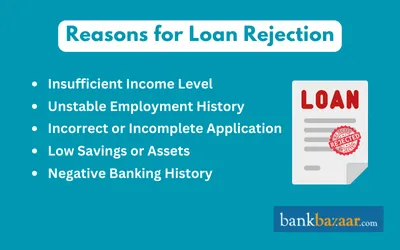
The table below summarizes the possible reasons for rejection of your loan even if your CIBIL score is good:
Reason for Rejection | Quick Summary |
Low or Insufficient Income | • Minimum income thresholds ensure borrowers can manage EMIs and living expenses. • Many lenders expect Rs.25,000 to 30,000 monthly income, though it varies. • Consistency and documentation of income affect approval of confidence. |
High Debt-to-Income Ratio (FOIR) | • FOIR measures how much income is committed to existing obligations. • High FOIR reduces disposable income for new loans. • Lenders may reject even good CIBIL applicants if FOIR is too high. |
Unstable or Unsatisfactory Employment History | • Steady employment signals reliable income. • Frequent job changes, gaps, or probation raise concerns. • Consistent work history improves approval chances. |
Incomplete or Inaccurate Documentation | • Complete documents are required to verify identity, income, and employment. • Missing or mismatched paperwork can delay or block approval. • Even minor errors may lead to rejection. |
KYC or Data Mismatch Issues | • KYC verification requires matching details across PAN, Aadhaar, and bank records. • Inconsistencies or outdated info trigger red flags. • Lenders may reject applications if verification fails. |
Multiple Recent Loan Applications | • Frequent applications in a short period suggest financial stress. • Lenders monitor recent enquiries for risk assessment. • High volume of applications can reduce confidence, even with good CIBIL. |
High Existing Debt Burden | • Large outstanding loans or EMIs signal financial overextension. • Lenders focus on affordability, not just repayment history. • Excessive obligations may lead to rejection. |
Borrowing Beyond Repayment Capacity | • Loan eligibility is calculated based on income, liabilities, and EMIs. • Requesting more than affordable increases rejection risk. • Realistic amounts improve approval odds. |
Lender-Specific Policies or Restrictions | • Each lender has unique policies and restrictions. • Criteria may include location, employment type, or internal risk rules. • Rejection may reflect policy mismatch, not creditworthiness. |
You plan and meticulously detail and define the amount you need to take out a loan for whatever purpose. You decide that all the finances you need are a simple loan approval away and you confidently march your loan application and highly respectable CIBIL score to the bank and submit them for consideration.
How to Avoid Loan Rejection?
The table below shows the steps you can take to avoid rejection of loans even if your CIBIL score is good:
Type | Action |
Check and Meet the Lender’s Income Criteria | • Review the lender’s minimum income requirements before applying. • Ensure your income is documented through salary slips, bank statements, or other accepted proofs. • A stable and verifiable income profile reassures lenders of repayment ability and avoids immediate rejection. |
Improve Your Repayment Capacity by Managing Existing Debt | • Reduce outstanding loans or pay down high credit card balances to lower your Fixed Obligations to Income Ratio (FOIR). • Lower FOIR signals sufficient disposable income to take on a new loan. • Even small reductions in debt can positively influence approval decisions. |
Apply When Your Employment Profile Is Stable | • Avoid applying immediately after job changes, during probation, or with employment gaps. • Completing a reasonable tenure in your current role signals income stability. • Consistent employment reduces perceived repayment risk and increases lender confidence. |
Ensure All Documentation Is Complete and Accurate | • Submit all required documents: identity proof, address proof, income statements, and bank records. • Check for errors or inconsistencies in personal details such as name, date of birth, or address. • Complete and accurate documentation avoids verification failures and reduces rejection risk. |
Keep KYC Details Updated and Consistent | • Ensure PAN, Aadhaar, bank details, and address proofs match across all records. • Update outdated information before applying. • Consistency across documents streamlines verification and prevents identity-related rejections. |
Avoid Submitting Multiple Loan Applications Together | • Limit applications to one or two lenders at a time. • Frequent enquiries may signal financial stress or urgent credit needs. • Research lender eligibility carefully and apply selectively to improve approval chances. |
Apply for a Loan Amount That Matches Your Eligibility | • Request a loan amount aligned with your income, liabilities, and repayment capacity. • Applying for an excessive amount signals poor financial planning. • Realistic loan requests demonstrate prudence and increase likelihood of approval. |
Choose a Lender That Matches Your Profile | • Understand lender-specific policies on employment type, location, and income structure. • If rejected by one lender, consider others whose criteria align with your profile. • Matching your profile with lender norms improves approval outcomes and reduces rejection risk. |
Why Your Loan Was Rejected Even with a Good CIBIL Score
Most banks take around 72 hours to approve loan requests and in this time you reflect on how you've done everything required to keep your CIBIL score high enough working hard to make your payments on time, paying the amount promised and play it straight with your bank never asking for extensions, reductions or settlements. You use your credit card in moderation and make your payments before they're due.
All this to get your CIBIL score up to a point that will ease the loan application process and ensure that loans are granted. Three days later, the bank performs its due diligence and informs you that your loan application has been rejected!
So What Went Wrong?
CIBIL scores, while they play a huge part in the process, are not the only thing that banks look at before sanctioning your loan. Banks and financial institutions also consider the following:
- Comments in CIBIL Reports - In addition to a numerical score, CIBIL reports also contain remarks and comments by lenders. Banks sometimes offer you the option to settle your loan for a slightly smaller amount than all of your EMIs combined, or offer interest rate reductions, etc. to help you clear your debt. If you settle your loan in any way apart from the terms on which you took the loan, there will be a remark about it in your CIBIL report and this will work against you. If there is any mention of loans being 'written off' or 'settled', or amounts being paid after the due date ('DPD' = Days Past Due), banks take these as warning signs and will reject your loan.
- Standing guarantor on a defaulted loan - A guarantor is considered to be as responsible for loan repayment (even if not in a purely literal capacity) as the borrower. If you have stood guarantor to a loan that has been defaulted, this will affect your CIBIL score and report in a negative way.
- Defaulter details matching - Banks and financial institutions maintain lists that contain the name, age, address, current employment, and other details of individuals who have defaulted on their payments. If the details you have submitted are (even mistakenly) matched with a defaulter, you will be denied a loan before the bank even checks your CIBIL rating. There have been instances where those who have moved into houses previously occupied by defaulters and submitted that address have been matched with the 'address' records of defaulters, suffocating their chances of securing a loan.
- If you are overleve'raged - You can only assign a certain amount of your declared income to clearing debts. If you earn Rs.50,000 per month, and have three other loans youre clearing by paying Rs. 10,000 per month, each, you're left with Rs. 20,000 for survival and personal expenditure. Banks will not approve another loan and will deem you overleveraged. Your DTI (debt-to-income) ratio will be unfavourable and you will not be able to allocate more of your income to clearing off your new loan.
- Inadequate tax-paying history - Banks generally prefer applications from those who have been actively filing income tax for at least two years prior to the application. It is easier to judge the creditworthiness of such individuals as there is an existing record apart from CIBIL that can nudge them in the right direction.
- Over-borrowing - If you have taken out too many loans in the previous year, regardless of whether you were able to honour them or not, banks will not approve your loan as they deem such individuals as credit hungry. Even though your record is clean, you will be considered a risky candidate who can default at any time.
- Ratio of secured loans to unsecured loans - Secured loans are those taken against securities like assets or with a guarantor (home loans, automobile loans, etc.) and unsecured loans are taken without any security (personal loans, credit cards, etc.). A favourable ratio would be one which has more secured loans than unsecured ones.
Anything else I should keep in mind to be viewed favorably by lenders?
As it's clear by now, sometimes loan applications can get rejected through no fault of your own, it is important to be diligent and actively involved in managing your finances. It's also recommended that you check your CIBIL report once every six months to ensure that everything is as you left it.
What is the Perfect Credit Score to Have a Credit Card Application Approved?
A credit score is just three digits and the importance given to those three digits by banks and other lenders has grown significantly over the years. Any loan a person is looking for: home loan, car loan, personal loan, or a credit card, the prospective lender check the applicant's credit history before approving the application.
So, what is the perfect score to avail a credit card? You can read on to find out.
A typical credit score ranges from 0 to 850 and the score between these are categorised into 5 different levels. The higher the score is, the better a person's chances are of getting a loan or a credit card. So, in the search of a perfect score, let's first see how they are categorised.
0 - 600:
Any score between this means that the lender will most likely be running for the hills when you apply for a line of credit line. This score shows that you are really Poor with money and handling loans. So, the only option for a person with score to get a credit card is by getting a secured card.
601 - 700:
While score between this range isn't as bad, as the previous category, it is still bad. Some lenders may not outright reject an applicant of this category, but they certainly will waste their time, scratching their head thinking if the applicant is worth the risk. There is a slightly high chance of rejection involved here though, unless they can opt for a secured card, as in the case of the previous category.
701 - 750:
This gets lenders talking. They are often waiting for people within this range to apply for a card. And, when they do, they mostly approve them. The case or rejection comes in when the applicant overreaches and applies for a card beyond their present ability. But, maintaining a score within this range means you are most likely walking away with a credit card in a few weeks time.
751 - 850:
This is the best possible applicant credit card company would look for. If your score is within this range and you meet the basic eligibility, your application for a new credit card is as good as approved. Scores within this range shows that the applicant is extremely reliable and carries little to no sense of risk for the lender. The score shows that the person will always clear bills on time and keep very little outstanding on their card and will always remain reliable and trustworthy for the bank.
As specified, banks never offer a loan or a credit card to individuals they think are a risk and those who run a high risk of defaulting. So, to sum it up it's always better to keep your credit score between 701 - 850 to have your application accepted at the earliest.
Disclaimer
Display of any trademarks, tradenames, logos and other subject matters of intellectual property belong to their respective intellectual property owners. Display of such IP along with the related product information does not imply BankBazaar's partnership with the owner of the Intellectual Property or issuer/manufacturer of such products.


FAQs on Reasons for Loan rejection
1.Why do lenders have requirements for minimum age and/or eligibility criteria?
Lenders have criteria for age and/or eligibility to make sure that the borrower will be able to repay the loan over the entire term. Someone who falls either below or above the specified age range may be refused the loan, even though there are no issues with their CIBIL score.
2.Can limited or thin credit histories affect loan approvals?
Yes. If a borrower has very few accounts or limited credit experiences, lenders will likely not approve them because there isn't enough data for the lender to accurately assess the borrower's ability to repay the loan.
3.Do signature or document discrepancies cause rejections?
Yes. When lenders evaluate new loan applications, they will look at the applicant's identified documents in addition to confirming the signature and identity on the documents submitted with the original loan application. If there are any inconsistencies with the loan application and supporting documents, there is a possibility that the applicant will be rejected.
4.Do issues with address verification cause denials?
If an applicant's existing addresses cannot be confirmed through supporting documentation (for example, Aadhaar card, utility bill, etc.), the lender's risk mitigation policy may require the lender to deny an applicant's loan application.
5.Will the type of employer influence loan approval decisions?
Many lenders have criteria for approving loans that take into consideration the type of employer and stability of the employer. For example, borrowers who work for unregistered companies or temporary positions may be assessed as a higher risk for loan approval than borrowers with stable and reputable employers.
6.Can errors in the application result in an application being rejected?
Spelling errors, out of date information and inconsistent application fields can create problems when it comes to verifying your application and may result in a denial.
7.Will irregular salary payments impact whether or not I’m approved?
Lenders will seek a steady and predictable cash flow and will view irregular deposits and overdrawn accounts as a signal of unstable income which will increase the chances that your application will be denied.
8.Will my application be denied if I state the reason for needing a loan incorrectly?
Many lenders have guidelines for the acceptable reasons for loans and if you state an incorrect reason for your loan, the lender may decline your application.
9.Does applying multiple times in a short period of time affect my chances of being approved?
If an applicant submits multiple loan applications within a short period of time, it sends a signal to the lender that they are experiencing financial distress and are dependent on credit. Lenders will consider this a higher risk even if the applicant has a good CIBIL score and deny all applications.
10.Will being close to retirement or being an older borrower be a reason my loan application is denied?
Lenders are likely to avoid lending money to a borrower that is nearing retirement age due to the unknown ability to repay the loan per the loan terms throughout the entire term of the loan.
CIBIL Score Requirements for Loans

Disclaimer
Credit Card:
Credit Score:
Personal Loan:
Home Loan:
Fixed Deposit:


Copyright © 2026 BankBazaar.com.