


How Is Your CIBIL Score Calculated?

Loading your search...
CIBIL score is calculated by analyzing factors such as payment history, credit utilization, credit length, credit mix and recent credit inquiries. These elements are assigned specific weights, and their collective assessment determines an individual's creditworthiness.
Maintaining a positive payment record and responsible credit management are crucial for a good Credit score.

What is a Credit Score?
A credit score is a numerical representation of your creditworthiness, calculated using data from your credit report. Lenders and other companies use the data to evaluate your creditworthiness to repay loans on time.
How is CIBIL Score Calculated?
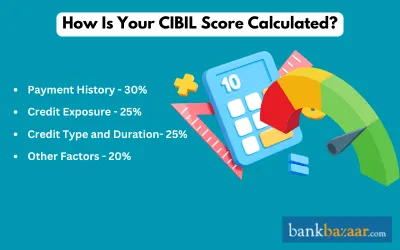
There are multiple aspects of your credit behavior that will determine the score given by the credit bureaus of TransUnion CIBIL. While their exact formula for scoring is not available, below are the most impactful factors for your credit score.
Key factors that influence the calculation of CIBIL score are mentioned below:
Payment History Approx (35%)
This indicates whether you have paid your loan EMIs and credit card bill on time or not. Paying all of your bills on time and on a consistent basis helps establish Financial Discipline, which is an important positive contribution towards building your credit score.
Credit Utilization Approx (30%)
Credit utilization refers to how much of your available credit you use - as a percentage. If you utilize a low percentage of your available credit, this is a good indication of responsible credit use on your part. If you consistently utilize a high percentage of your available credit, this may be an indication of poor credit use, which will negatively impact your credit score.
Length of Credit History Approx (15%)
- The length of credit history looks at how long your credit accounts have been active. Having a longer credit history will allow creditors to have more of an idea of your borrowing and repayment habits over time.
Credit Mix Approx (10%)
- Credit mix is a measure of the different types of credit accounts you possess, such as secured loans (home and auto loan) and unsecured credit cards and personal loans). You will have a better chance of obtaining good scores if you maintain a healthy mix of the different types of credit accounts you hold.
New Credit and Enquiries (approximately 10%)
- This factor looks at the number of recently opened credit accounts and the number of hard enquiries made by lenders when you apply for new credit. Frequent credit applications within a short period may signal higher credit risk.
Factors That Do Not Affect Your CIBIL Score
Your CIBIL score is calculated using credit-related information reported by lenders. Many personal or financial details are not considered in the scoring model used by TransUnion CIBIL. Listed below are a few of such factors:
Factor | Explanation |
Soft Enquiries and Self-Checks | When you check your own credit score or use pre-qualification tools, it creates a soft enquiry. Soft enquiries do not affect your credit score. Only hard enquiries from actual loan or credit card applications are recorded for scoring purposes. |
Income and Employment Details | Salary, employer information, or employment status may be collected during loan applications, but these details are not directly used to calculate your CIBIL score. The score mainly reflects your credit repayment behaviour. |
Savings and Investment Accounts | Bank savings accounts, fixed deposits, mutual funds, and demat investments are not considered in the credit scoring process. The score focuses only on borrowing and repayment activity. |
Debit Card and UPI Transactions | Payments made using debit cards, UPI, digital wallets, or cash are not linked to credit borrowing. Therefore, they do not influence your credit score unless they are connected to a credit facility. |
Personal Demographics | Characteristics such as age, gender, marital status, religion, education, or nationality are not used in the credit scoring model. Scores are based on financial behaviour rather than personal identity. |
Non-Credit Financial Activities | Expenses like rent, electricity bills, mobile bills, broadband payments, and subscription services generally do not affect your score unless they are associated with a credit account reported to a credit bureau. |
Legal Matters Unrelated to Credit | Civil disputes, criminal cases, or traffic violations do not impact your credit score unless they result in a loan default or another credit account being reported negatively. |
Address or Location | Your city, PIN code, or frequency of address changes does not affect your score. Address details are recorded only for identification purposes in your credit report. |
Who Calculates the CIBIL Score?
India has one credit reporting agency, TransUnion CIBIL, that generates CIBIL scores. CIBIL was previously known as the Credit Information Bureau of India Limited and is regulated as per the Credit Information Companies (Regulation) Act, 2005 by the Reserve Bank of India.
The credit bureaus are in charge of collecting financial information from banks, non-banking financial companies (NBFCs) and other lenders. These records include:
- information about all your loan accounts
- credit card use
- your repayment history
- any existing loan balances and credit inquiries you have made.
Note: The credit bureau uses these records to develop your credit report and generate your credit score to assist lenders in assessing your credit behaviour and ability to repay.
Credit bureaus in India that issue credit reports and credit scores are:
- TransUnion CIBIL: The first credit bureau in India, it is the primary source for the CIBIL score.
- Experian: An international credit reporting agency providing both reports and scores for Indian consumers.
- Equifax: A worldwide credit bureau providing reporting and analytics services.
- CRIF High Mark: A credit bureau primarily providing data service related to credit to retail and microfinance.
All these bureaus receive credit-related information from lenders and use their own scoring models to calculate credit scores. Because each organisation uses a different algorithm, the credit score generated by one bureau may not be identical to the score provided by another. Financial institutions typically review these credit reports and scores when assessing a borrower’s eligibility for loans or credit cards.
What is the Ideal CIBIL Score you Should Have?
The details of range of CIBIL score and their meaning are given in the table below:
CIBIL Score Range | Meaning |
750 - 900 |
|
700 - 750 |
|
550 - 700 |
|
300 - 550 |
|
Ideal CIBIL Score Rating For Different Types of Loans
The CIBIL score rating for different types of loans are listed in the table below:
Loan | Ideal CIBIL Score |
Personal loan | Above 700 |
Home Loan | Above 650 |
Loan against Property | Above 650 |
Car Loan | Above 700 |
Business Loan | Above 700 |
Gold Loan | Not Required |
How to Check CIBIL Score Online?
Here are the steps to check the CIBIL Score online:
Step 1: Visit the official CIBIL website
Step 2: Select ‘Get Your Credit Score’. You can also click on ‘Check my CIBIL score’.
Step 3: Enter the required details, such as email address, password, first name, last name, ID type, ID number, Pincode, and mobile number.
Step 4: Click on ‘Accept and Continue’.
Step 5: Type in your personal verification details
Step 6: Select ‘Proceed to Payment’. You may access your free annual credit report or choose a paid plan for additional reports and monitoring features.
Step 7: Make payment for the same
Step 8: Your CIBIL report and your score will be sent to your email.
Improving Your CIBIL Score
The following are the points that should be remembered to improve your Credit score:
- Pay Your Dues on Time: Ensure that you pay all your credit card bills and loan EMIs before the due date. Timely repayments demonstrate financial discipline and have a positive impact on your credit score, while delayed or missed payments can significantly lower it.
- Maintain a Low Credit Utilisation Ratio: Try to use only a small portion of your available credit limit. A high credit utilisation ratio may indicate heavy reliance on credit and can negatively affect your credit score.
- Avoid Applying for Multiple Loans or Credit Cards: Submitting several credit applications within a short period can result in multiple hard enquiries on your credit report. This may signal high credit dependency and may reduce your credit score.
- Clear Outstanding Dues Promptly: If you have any overdue balances or past-due accounts, clear them as soon as possible. Settling outstanding dues and bringing accounts back to good standing can help improve your credit profile over time.
- Monitor Joint or Co-signed Accounts: If you have joint accounts or have co-signed a loan, you share responsibility for repayment. Any delay or default in such accounts can negatively affect your credit score.
- Maintain a Healthy Credit Mix: Having a balanced combination of secured loans (such as home or vehicle loans) and unsecured loans (such as personal loans or credit cards) can positively influence your credit profile.
- Keep Old Credit Accounts Active: Maintaining older credit accounts can help increase the length of your credit history. A longer credit history allows lenders to better evaluate your credit behaviour.
- Check Your Credit Report Regularly: Review your credit report periodically to ensure that the information reported is accurate. If you notice any errors or incorrect entries, raise a dispute through the official platform of TransUnion CIBIL Limited.
Disclaimer
Display of any trademarks, tradenames, logos and other subject matters of intellectual property belong to their respective intellectual property owners. Display of such IP along with the related product information does not imply BankBazaar's partnership with the owner of the Intellectual Property or issuer/manufacturer of such products.
CIBIL Related Articles
- CIBIL
- Hidden facts about CIBIL Score
- CIBIL Myths
- How Credit Information is important
- CIBIL Redressal Process
- Credit Report for Business Loans
- CIBIL Dispute and Its Resolution
Know More About CIBIL
TransUnion CIBIL is one of the leading credit information companies in India. The company maintains one of the largest collections of consumer credit information in the world. CIBIL Score plays a key role in the lives of consumers. Banks and other lenders check the CIBIL Score of the applicants before approving their loan or credit card application. Consumers can visit the official website of CIBIL to check their CIBIL Score and Report. CHECK YOUR CIBIL SCORE now.


FAQs on CIBIL Score Calculation
1.Is a credit score the same as a CIBIL score?
A credit score is a broad term for a numerical representation of creditworthiness, while the CIBIL score is an exact form of credit score produced by Transunion CIBIL. In India, there are several credit bureaus that produce a variety of different credit scores, Experian, Equifax and CRIF High Mark; since each bureau uses its own score-calculation method, it is possible for conflicting scores to appear.
2.How can I check my CIBIL score online for free?
You can find your CIBIL score on their official web page by creating a new account, entering your personal information, and completing your identity verification, then retrieve your credit report. Consumers are entitled to one free credit report a year and can obtain other reports or monitoring services with paid subscriptions.
3.Does a loan rejection affect my CIBIL score
Being denied for a loan will not have an impact on your CIBIL Score, but when you apply for a loan or credit card the lender usually performs a Hard Enquiry into your credit report, which will result in a decrease in your score when multiple Hard Enquiries occur in succession.
4.How often is my CIBIL score updated?
CIBIL Scores will be updated every time you receive new credit information provided to the Bureau by a Lender. Usually this happens on a monthly basis, however, the actual date can vary depending on the Lender's timetable for reporting.
5.Can you check your own CIBIL score without affecting it?
Yes, if you check your own credit score it generates a 'soft inquiry', which will not affect your CIBIL score. Only 'hard inquiries' made by lenders when applying for credit will minimally impact your score.
6.How is my CIBIL score calculated?
Your CIBIL score is based on data in your credit report, and reflects factors such as repayment history, credit utilization and mix, length of credit history and recent inquiries for credit. The calculation method used by TransUnion CIBIL to produce a score is proprietary and is not publicly available.
CIBIL Score Requirements for Loans

Disclaimer
Credit Card:
Credit Score:
Personal Loan:
Home Loan:
Fixed Deposit:


Copyright © 2026 BankBazaar.com.