


Missing a Single Payment Can Affect Your CIBIL Score

Loading your search...
CIBIL score is an important parameter used by banks or financial institutions to gauge an individual's creditworthiness and their ability for loan repayment. Founded in 2000, CIBIL or the Credit Information Bureau of India Limited (CIBIL) has a record of individual's loans and credit cards.

Maintenance of a healthy credit profile is a difficult task. Multiple factors negatively affect a good CIBIL score. Missing a single payment affects your financial standing. Frequency and Severity of late payments also affects the CIBIL score which begs the question: does every single missed payment impact your score.
Financial Discipline is the Key
More often than not, most of us underestimate the importance of timely payments and, therefore, end up paying our bills past the last date. Not paying the bills on time leads to additional fees that silently eat up into your savings. It does not augur well for you in terms of your financial discipline in the long-run.
Establishing a routine of punctual payments is essential for a healthy economic lifestyle. With the advent of credit bureaus such as CIBIL, you delay payments of your bills at your own peril.
Effect of Delayed or Missed Payments on Your Credit Rating
A single missed payment can reduce your CIBIL score and thereby decrease your credit worthiness. Consistently making payments on time is the most effective way to demonstrate financial reliability to potential lenders. Banks and other financial institutions might turn down loan requests while credit card companies which periodically review their customers' profiles might reduce the credit limit on a card if the CIBIL score is low.
Moreover, maintaining a strong score is essential for securing the most competitive interest rates on personal or home loans. Credit card issuers would like to ensure that your payment record is clean before they offer you higher credit limits.
Minor and Major Defaults
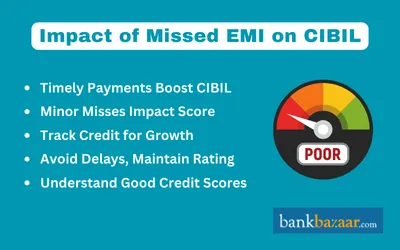
Customers would do well to understand the difference between minor and major defaults. It is also worth noting that different lenders may have varying thresholds for what they consider a high-risk applicant. Payments delayed or missed for a period of less than 90 days are considered minor defaults. As a result, your CIBIL score does get af.fected, but it is temporary.
Payments delayed or missed for a period of less than 90 days are considered minor defaults. As a result, your CIBIL score does take a permanent beating but is affected temporarily.
However, if you fail to make payments beyond 90 days, your account falls under the NPA (non-performing assets) category. In case of major defaults such as this, lenders wouldn't touch you with a bargepole. Proactively contacting your lender to discuss a repayment plan can sometimes mitigate the damage to your report before it reaches a critical stage.
In both scenarios (major and minor defaults), loan eligibility of a customer gets affected. In case of a minor default, you can ensure that you pay subsequent bills in a timely manner to see your CIBIL score recover. Automating your bill payments through your bank can prevent these oversights and help maintain a consistent credit history.
There is a view that a single payment delay will not have a huge negative impact on your CIBIL credit score provided you can make up for the time lag. However, it all boils down to the timing and the frequency of your missed payment.
A couple of missed payments may only affect your score for a short period but if you don't make a missed payment for six months and plan to apply for a loan, your chances of getting a loan approved are miniscule.
Furthermore, the total amount of outstanding debt relative to your credit limit plays a significant role in the overall calculation of your score.
Of Scores and Percentages - What Is a Good Credit Score?
According to data shared by CIBIL
- For individuals with a score ranging anywhere from 650 to 699, the percentage of loans sanctioned stood at 5.2% last year.
- For individuals with a credit score ranging from 700 to 749, the percentage of approved loans was 9.7%.
- For individuals with credit scores of 750 t0 800 and above, the percentage of loans sanctioned stood at 57.6% last year.
It is, therefore clear that a high CIBIL score would only increase your chances of getting a loan.
How Payment Delays Affect Your Credit Rating
Smriti Thakur, a Jaipur-based banker, bought a two-bedroom apartment a couple of months ago. Smriti who has a small car, has been waiting for an annual raise by her firm, to buy an SUV.
Smriti's CIBIL score was around 750 when she bought her first car two years ago. However, when she decided to apply for a loan for an SUV, her application was rejected, much to her dismay. Her bank informed her that they could not process her application owing to her low CIBIL score in addition to a few remarks on her credit report.
Consequently, Smriti found out that her personalised CIBIL score was 610. After she perused her bills and payment record, she discovered that she was guilty of making late payments on her EMIs on her car loan. She was also responsible for delayed credit card payments.
Fixing Your CIBIL Report
Smriti (in the above example) learnt the hard way that it is always advisable to review one's credit history on a regular basis to avoid getting rude shocks from banks and financial institutions. Experts often suggest keeping your credit utilization ratio below 30% to demonstrate responsible borrowing behavior. There are several other precautionary measures one can take such as ensuring a healthy credit mix, in that it is always prudent to have a combination of secured (home, auto loans) and unsecured (personal loan, credit cards). Low utilization of credit and not being 'credit hungry' also help in improving your CIBIL score. Disputing errors on your report immediately is a crucial step if you notice discrepancies in your personal information or loan details. One would also do well to monitor joint accounts on a monthly basis since you will be held liable for missed payments.
If you are closing a credit card account, make sure you get a no objection certificate (NOC) from a credit card provider. Furthermore, frequently applying for new loans in a short window can result in multiple hard inquiries, which negatively impacts your standing. Credit cards are closed only after NOC is received from the bank. Your CIBIL database should, therefore, be updated by the bank within 45 days. If you don't check to ensure that the process is on track, your CIBIL score will take a beating for no fault of yours.
Setting up automated payment reminders can be a life-saver for those who struggle to remember various due dates throughout the month. While it takes years to build a strong credit record, it only takes a few instances or lapses, intentional or otherwise to damage your credit history. With credit checks gaining greater importance in the Indian financial system, financial diligence and discipline are key to maintaining a high CIBIL score.
While it takes years to build a strong credit record, it only takes a few instances or lapses, intentional or otherwise to damage your credit history. With credit checks gaining greater importance in the Indian financial system, financial diligence and discipline are key to maintaining a high CIBIL score.
Ways to Improve your CIBIL Score
- Pay your credit card bills on time: Timely credit card bill payments are one of the simplest ways to boost your credit score. You may not see the improvement overnight, but it will gradually boost your credit score.
- Maintain a low credit utilisation ratio: Credit utilisation ratio indicates the amount of credit you have used from the total available credit. A high credit utilisation ratio projects you as credit hungry, which has a negative impact on your credit score. It is advisable to keep your credit utilisation ratio below 30% of your total credit limit.
- Avoid frequent loan applications: Applying for multiple loans or credit cards within a short period creates hard inquiry on your credit report, which can lower your score.
- Avoid closing old credit cards: Old credit card accounts, especially the one with good credit history, contribute positively to your credit score. It is advisable to avoid closing old credit cards unless necessary.
- Regularly check your credit report: Review your credit report periodically to ensure there are no errors or frauds. Dispute any incorrect entries with the credit bureau.
- Maintain a healthy mix of credit: A balanced mix of secured (home loan, auto loan) and unsecured credit (personal loan, credit card) can improve your score, provided you manage repayments well.
Disclaimer
Display of any trademarks, tradenames, logos and other subject matters of intellectual property belong to their respective intellectual property owners. Display of such IP along with the related product information does not imply BankBazaar's partnership with the owner of the Intellectual Property or issuer/manufacturer of such products.
Read More on CIBIL
- Know the factors that affect CIBIL Score
- Mistakes That can negatively impact your CIBIL Score
- CIBIL Myths
- CIBIL Redressal Process
- Are you in a credit card debt?
- What is Considered as a Bad Credit Score
- Factors Deciding Your CIBIL Score
- Pay Education Loan or Your CIBIL Score Suffer
- Are you in a credit card debt?
- What is ECN Number


FAQs on Missing Payment Effect On CIBIL Score
1.How can I fix my credit score after a late payment?
You can fix your credit score after a late payment by setting up automatic payments ensuring that your payments are made on time. Ensure that all the bills due are cleared by date.
2.Can a missed payment be removed?
A late payment can only be taken off your credit report in the event that it was incorrectly reported. That indicates that although you made the payment on time, it was incorrectly recorded as being received beyond the due date by a credit bureau. If such is the case, you must understand how to challenge incorrect late payments.
3.Does one missed payment affect credit score?
There are no limits to the inquiry of credit score. You can check your credit score as many times as you need to. The inquiry for the credit score is considered as a soft check while only hard checks can impact your credit score.
4.Does one day late payment affect CIBIL score?
Payments which are less than 30 days overdue are not reported to the credit bureaus by credit card issuers. If your payment is overdue by 30 days or more, there may be additional fees.
5.Can checking my own credit score frequently lower it?
No, checking your own credit score is considered a "soft inquiry" and does not affect your CIBIL score at all. In fact, it is recommended to monitor your report regularly to catch any potential errors or unauthorized activities early, ensuring your credit profile remains accurate and healthy.
6.How does "settling" a credit card of debt differ from "paying in full"?
Settling a debt means the lender agreed to accept a lower amount than what you originally owed, which usually results in a "Settled" status on your report rather than "Closed" or "Paid in Full." While this stops further collection efforts, it can negatively impact your CIBIL score for several years as it indicates you did not fulfill the original loan agreement.
7.Is it possible to improve my CIBIL score if I have multiple credit cards?
Yes, having multiple credit cards can actually help your score if you maintain a low credit utilization ratio across all of them. By keeping your total spending well below your combined credit limit, you demonstrate to lenders that you can manage credit responsibly without being over-leveraged.
CIBIL Score Requirements for Loans

Disclaimer
Credit Card:
Credit Score:
Personal Loan:
Home Loan:
Fixed Deposit:


Copyright © 2026 BankBazaar.com.